
Learn Korean from the video you already watch.
You've been reading subtitles, not hearing Korean. Tap any word in a real clip and you get what it means, and what it's doing in that sentence.
The moment it starts working.
Day 47
I've started and quit Korean four times. This is the first thing that's stuck, because it doesn't feel like studying. 47 days straight and 380 saved words.
Understood a whole scene
Was rewatching something on Netflix and realized I'd understood a full exchange without reading the subtitles.
Started not knowing the alphabet
Three weeks ago I couldn't read hangul at all. It gave me an alphabet deck first, and I can read now, slowly, and pick words out of the clips.
Worth every dollar
Signed up for the year after the trial, about $4 a month. Less than one coffee a week to sit in a cafe and not study. Worth it.
You're not bad at Korean. You've been practising the wrong thing.
Hundreds of hours of Korean on your screen and you still can't follow a scene. That isn't a discipline problem, and another streak won't fix it.

Subtitles do the listening for you
Your eyes get the workout. Your ears sit it out, for hours, and you finish the episode knowing the story and none of the Korean.
Streaks measure the app, not you
A 400-day streak says you opened something 400 times. It says nothing about whether you'd catch a single line of what you watched last night.
Drills teach you to do drills
You get very good at putting four tiles in order. Nobody is ever going to hand you four tiles. The sentences were built to show a rule, not to be said out loud.
Understanding real Korean a little above your level, over and over, is the one thing that reliably works.
Linguists call it comprehensible input. Stephen Krashen spent decades at USC showing that you acquire a language when you understand messages, not when you memorise rules.
The catch has always been finding real material you can nearly follow, and getting over the words you can't. That is the whole job Soritok does, around the thing you already do most evenings.
A dictionary gives you a word. You needed the sentence.
What a dictionary says
mum, mummy
What Soritok says, in this line
엄마 is 'mum', the way a child says it. Peppa calls Mummy Pig 엄마 all through the episode; the grown-up word is 어머니.
Watch. Tap. Meet it again.
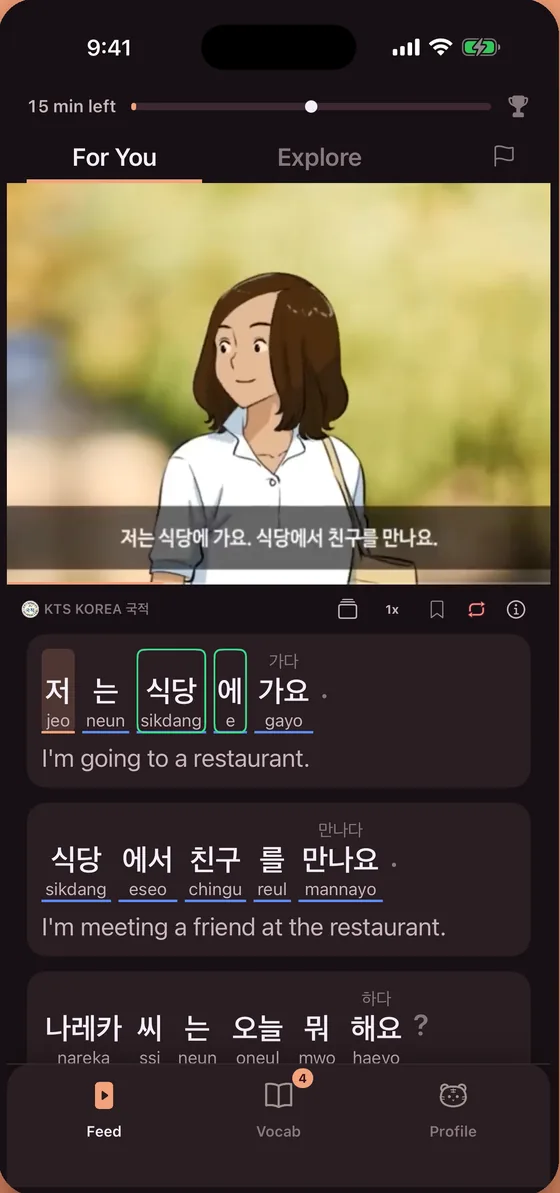
Watch something you’ll finish
Clips picked for your level, thirty seconds rather than thirty minutes, so you get to the end of one. The transcript lights up word by word as they speak, and you can halve the speed or loop the line you can't catch.
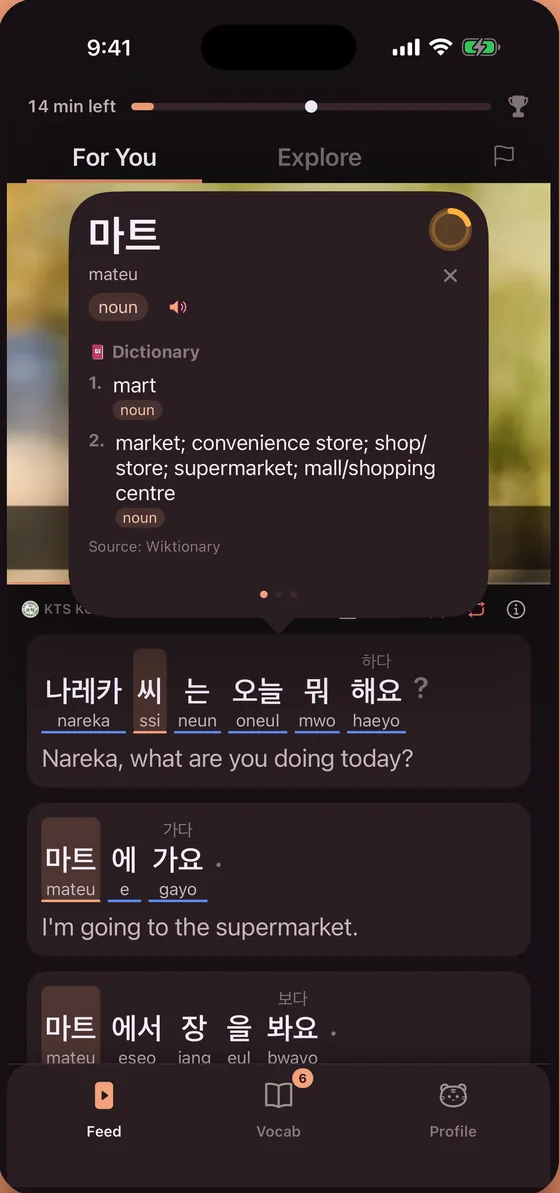
Tap the word that stopped you
The card opens over the video without taking you out of the scene: meaning, dictionary form, how it sounds, and what the word is doing in this line. No screenshotting it into a translator and losing the thread. Tapping saves it, unless you'd rather it didn't.
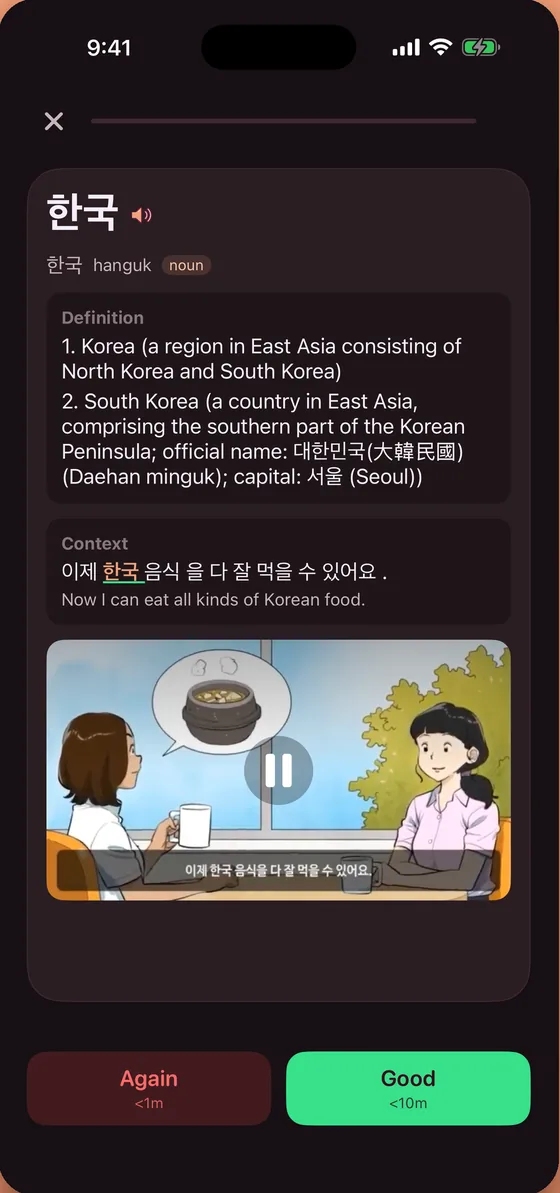
Meet it again until you own it
Saved words return as flashcards with the clip they came from on the back. You are not recalling a word on a card, you are recalling somebody saying it. A minute, ten minutes, a day, three days, then wider as you get it right.
Swipe →
One hour with a tutor, or a year of this.
The hour happens once. This happens every night, in the time you were already going to spend watching. The first seven days are free.
Or go month to month at $12.99, without the trial.

Before you ask.
I've quit Korean before. Why would this be different?
Because you don't have to make time for it. The thing that kills most attempts is that studying is a separate activity you have to choose over something you'd rather do. Here the something you'd rather do is the lesson.
It also doesn't punish you for missing a day. There's no streak to break and nothing guilt-tripping you back.
How long before I can follow something without subtitles?
Honestly, that depends on how much you watch, and anyone giving you a number is guessing. What we can tell you is the first milestone people actually hit: around three weeks in, you stop decoding hangul letter by letter and start catching whole words in real time.
Whole scenes without subtitles take longer than that, and it creeps up on you rather than arriving on a particular day.
What am I actually watching?
Real Korean video, cut into clips and tagged by level: conversation channels, a Seoul travel vlog, an SBS variety show, and children's dubs, which are slow, clear and built from exactly the words you need first. Both clips on this page are straight out of the catalogue.
It is not a drama library, and we're not going to hang K-drama posters here and let you assume it is.
How is this different from Duolingo?
Duolingo is a game about Korean. You put tiles in order, a bird congratulates you, and the sentences were written to demonstrate a rule rather than to be said by anyone. It's genuinely good for your first few hundred words and then it stops being what you need.
There are no points here and nothing to beat. You watch real Korean, tap what stops you, and meet it again until it's yours.
I can't read hangul yet. Is that a problem?
No. The app hands you the Hangul deck before any clip: forty letters, ten syllable blocks. Three weeks from nothing to picking words out of what you're watching is a normal run.
Who writes the explanations?
They're drafted by a model and then read by a person before the clip goes live, which is why they're already there when you tap instead of spinning. A clip whose transcript isn't confident enough never gets published at all. Find a wrong one and tell us; it gets rewritten.
What happens to the words I save?
They come back as flashcards with the clip on the back, so the word arrives attached to the person who said it. A minute, ten minutes, a day, three days, then wider as you get it right. Export to Anki or CSV whenever you like.
When does it launch?
It's with Apple now. We're not going to give you a date we might miss, and iPhone comes first. If you're on Android, leave your address below and you'll get one email the day that build is ready.
Put it on your phone tonight.
Nearly there.
Seven days free. Watch one clip, tap one word, and see whether it does the thing nothing else has.
Soritok is with Apple now. iPhone first, Android next.